Graduate Trombone Recital #2 - May 1st, 2026
風花賛礼 (Breeze in the Hearts, Bloom in the World) - 2010 (Revised in 2023)
Keiko Takashima (b. 1962, Takamatsu, Japan) studied composition at the Tokyo University of the Arts and has written extensively for trombone (especially for trombone quartet), following early collaborations with the Paris Trombone Quartet. She also composed fanfares for the 1998 National Sports Festival in Hiroshima.
Breeze in the Hearts, Bloom in the World was commissioned and premiered by Takenori Yoshikawa with pianist Iku Miwa in 2010. After the work was extensively performed in Japan, Takashima sought to revise the work. Takashima mentions in the revised work that she sought to strike a better balance between the trombone and the piano, to make it a true sonata for both instruments. The work is in four movements: Andante – Allegro maestoso, Nostalgia, Serenade, and Allegretto tempo giusto.
Its Japanese title, Fūka Sanrei (“Praise for the Wind Flowers”), refers to flowers that bloom when the wind passes between people, symbolizing encounters and connection.
Concertino in F-Dur (Fassung für Bassposaune) - 1944-45
Ernst Sachse (1813–1870) was a Saxon court musician in Weimar and a virtuoso trombonist and trumpeter who worked with Franz Liszt and performed in the premiere of Richard Wagner’s Lohengrin. Much of his compositional output was for brass instruments, often for his own performance. There is much discourse regarding the exact dates that Sachse lived. Many sources state that Sachse lived from 1810 to 1849, and likewise report that he performed at the premiere of Wagner’s Lohengrin. However… The premiere of Lohengrin occurred on August 28th, 1850.
The exact composition date for the Concertino is unknown, as Sachse originally wrote it to be performed by himself on e-flat cornet. There are mixed reports of him performing the work in 1844-45, with the work being published in 1879 (for tenor trombone in Bb), after his death. It is now frequently performed by bass trombonists, often in F major. Sachse’s Concertino bears similar compositional elements to Ferdinand David’s Concertino, which was composed and premiered in 1837 in Leipzig, around 100km from Weimar, where Sachse resided. Both works are great examples of German Romantic writing for solo brass instruments.
Devil’s Waltz - 2010
Steven Verhelst (b. 1981, Wilrijk, Belgium) studied bass trombone at the Royal Flemish Conservatory and the Rotterdam Conservatory with teachers including Ben Haemhouts and Ben van Dijk. He has performed with major Belgian orchestras and is an extremely active composer for brass.
Devil’s Waltz is an unaccompanied work for bass trombone duet written for Martin Schippers and Tomer Maschkowski. This work is now part of a trilogy of bass trombone duets, collectively titled Heaven or Hell. The three unaccompanied works in the set are Devil’s Waltz (2010), Angels Tango (2016), and Limbo Dance (2023). In 2023, Verhelst took the unaccompanied Devil’s Waltz and Angel’s Tango and expanded them into a singular work (Heaven or Hell), adding accompaniment (either piano, wind ensemble, orchestra or brass ensemble), and the final movement Limbo Dance.
Sonata for Trombone and Piano - Ke konci století (tr. at the end of the century) - 1997
Juraj Filas (1955–2021) studied voice and composition at the Prague Conservatory before continuing composition studies at the Prague Academy of Performing Arts with Jan Zdeněk Bartoš and Jiří Pauer. He later taught at the same institution.
A three-time Young Composer Laureate in Ostrava, Filas also received the European Prize of Gustav Mahler in 2008. Filas described his compositional goals as inspired by his faith in music’s power to heal wounds, open hearts, and bring peoples together.
His Sonata for Trombone and Piano “At the End of the Century,” was dedicated to Joe Alessi. This work features an intricate dialogue between the piano and trombone, with the mix of muted and sometimes stormy passages evoking the anxieties of Y2K, as the end of the century approached.
Blue - A Broken Glass Bottle - 2017
Ryan Middagh (b. 1985, Cedar Rapids, Iowa) holds degrees from the University of Northern Iowa, Middle Tennessee State University, and the University of Northern Colorado. Originally trained in music education, he established himself as a saxophonist in Nashville and is now Director of Jazz Studies at Vanderbilt University.
Middagh has worked with numerous prominent artists and ensembles and is active as a composer, arranger, and educator. His work is strongly influenced by jazz traditions and incorporates improvisation and flexible approaches to sound and texture.
Blue - A Broken Glass Bottle was commissioned and premiered by Jeremy Wilson, and is written for trombone and looping station. This work is in three sections, with a reprise of the opening section at the end. This piece was originally written to be performed with a Boss RC-300 Looping Station plus additional effects. For my performance, I will be using a Boss RC-600 Looping Station and a Boss GT-1000 Effects Unit. Throughout this work, I will be recording and overdubbing audio in real-time, building my own accompaniment for the work. This piece also features large sections of improvisation.
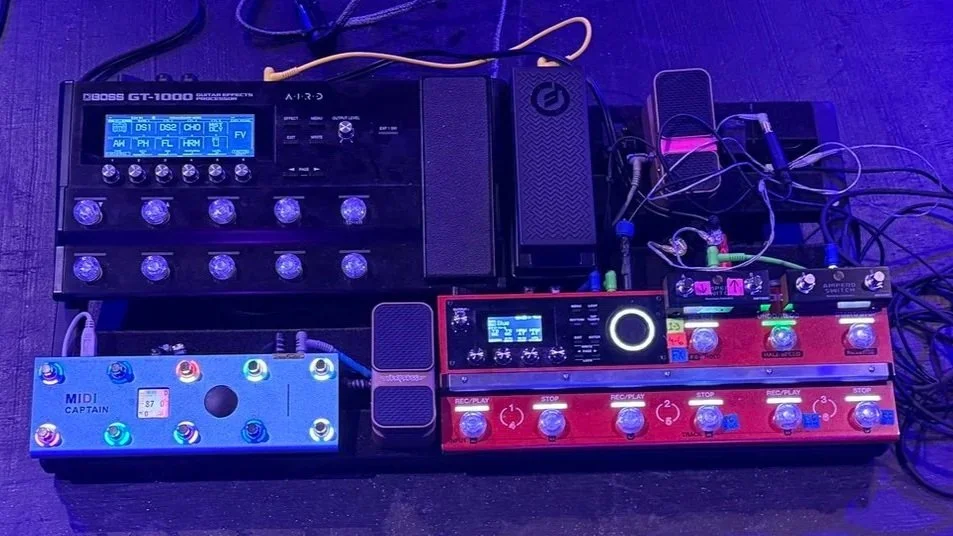
Top: Boss GT-1000 Guitar Effects Unit
Bottom: Midi Captain (Midi Controller), Boss RC-600 Looping Station
Crossroads
Joseph Spaniola (b. 1963, Owasso, Michigan) holds degrees from Michigan State University and the University of North Texas. He served as Chief Composer/Arranger for the U.S. Air Force Academy Band and is currently Professor of Music and Director of Music Theory and Jazz Studies at the University of West Florida.
Spaniola has worked with a wide range of artists and ensembles, and his compositions have received numerous awards and international performances. His musical influences span jazz, popular, and classical traditions, including artists such as Gerry Mulligan, Stan Kenton, and Aaron Copland.
Crossroads was commissioned and premiered by Paul Compton, and was originally written for a soloist with a trombone quintet (later adapted for piano). This work opens with a driving and dissonant motif in the quintet that returns throughout the remainder of the work. This work plays with the idea of a crossroads in musical styles, mixing lyrical and technical sections together.